
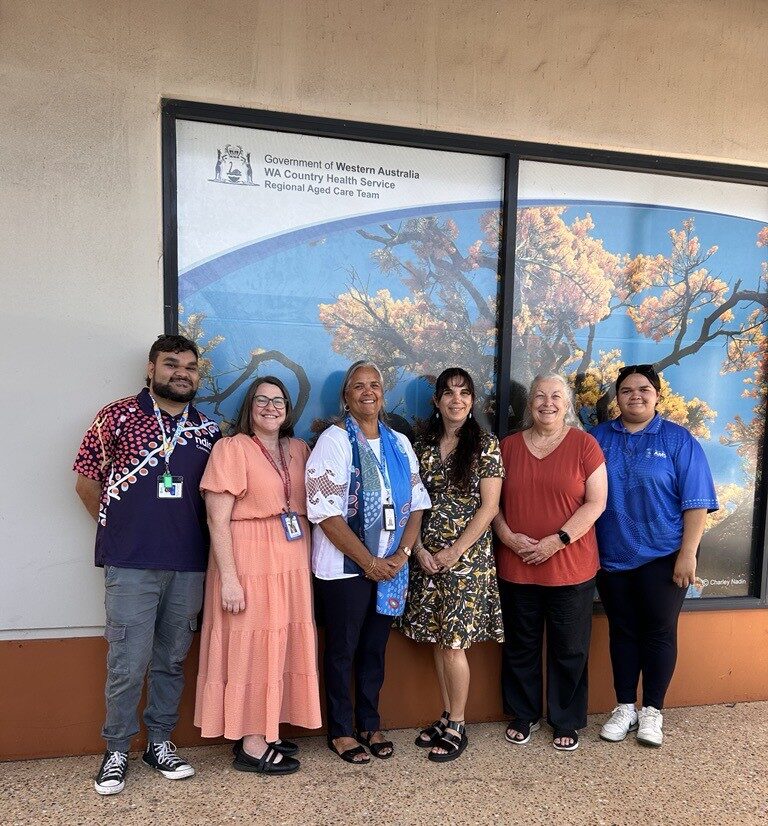
When Tahnee Nesbitt sits with an older person to guide them through the complexities of Australia’s aged care system, the atmosphere shifts. Shoulders relax, conversations flow more naturally, and trust begins to flourish. For many Aboriginal people, seeing an Aboriginal face in this space makes all the difference.
Tahnee is one of only two Aboriginal Aged Care Assessment Team (ACAT) assessors in WA and just one of around 14 across the country. In this role, she prioritises assessments for Aboriginal people identified for the Transitional Care Program (TCP) run by South West Aboriginal Medical Services (SWAMS). This is vital, not only in ensuring Aboriginal people accessing aged care services receive culturally safe assessments, but also in breaking down barriers that have historically kept many from accessing the support they need.
Growing up in Papunya, an Aboriginal community near Alice Springs, Tahnee never imagined she would one day be guiding Aboriginal Elders through the aged care system. Her early career was focused on children, working in community services, counselling, and behaviour management.
But as her career progressed, she began to see how the same barriers that affected young people were also impacting older generations. It was during her work with WA Country Health Service that she noticed the need in aged care.
“We were having trouble getting Aboriginal patients assessed before they left hospital,” Tahnee said.
“People didn’t always feel culturally safe during those assessments, and that meant they were less engaged or hesitant to share. My boss suggested we train more Aboriginal people as assessors and that was a lightbulb moment.
“When the opportunity came up, I thought, why not? I get to help my people, especially our Elders, and make the process feel safe and respectful. It was a no-brainer.”
Tahnee completed the online training, and just a few months later she was shadowing experienced assessors in the field. Before long, she was conducting her own assessments.
“Research shows that when services are delivered by Aboriginal people for Aboriginal people, outcomes are better,” she said.
“Engagement is better, we just talk the way we naturally do, and that helps people open up.”
Tahnee said when working with Aboriginal Elders, the connection is felt most in the little moments, like introducing herself as an Aboriginal person.
“I see their body language change instantly,” she said.
“They relax. They feel comfortable and that’s everything in this line of work, especially when you’re asking personal or sensitive questions. The assessments often cover difficult ground including health challenges, living arrangements, and even painful personal histories.
“For Elders who lived on missions or are part of the Stolen Generations, these questions can trigger trauma. I know I don’t have the right to pick at that wound. If someone doesn’t want to share their social story, I respect that. I’ll just write in the plan that they chose not to provide the information. It’s about being trauma-informed, giving people autonomy, and keeping the process safe.
“Sometimes, it’s also about being flexible. For example, when a male elder was uncomfortable with intimate questions, I asked if he’d prefer a male staff member to step in. It’s just about being creative and respectful.”
Despite her natural ability to connect with people, Tahnee did encounter some challenges along the way including learning a new language used by health professionals.
“Coming from a non-clinical background, I had to learn the ‘language’,” she said.
“I had to get used to all the acronyms and jargon. Things that seemed logical to me weren’t always written the way assessors needed them. Luckily, everyone in the office, from managers to admin, helped me learn. They’d explain things, show me how to structure reports, and give feedback so I could improve. That support made all the difference.
“Every single person in the office showed me something I could take on board. I wasn’t left to figure it out alone and that made me more confident in the role.”
In many areas of WA, aged care assessments are carried out by regional mobile workforce assessors at scheduled times of the year. For Aboriginal families, this limited access is compounded by cultural and social barriers.
“Shame is a huge factor,” Tahnee said.
“If there’s been a funeral and you’ve had other people staying in your house, you might be worried about the mess. Or if a family member is struggling, you don’t want a stranger judging you. That’s why many Aboriginal people won’t let service providers into their homes. But they know I don’t care what their home looks like. What matters is that they’re okay and people sense that. They know I get it.”
This cultural understanding means assessments are more accurate, services are more likely to be accepted, and Elders feel safe rather than judged. Tahnee would like to see more Aboriginal representation in ACAT teams and throughout aged care services and believes the change must start with training pathways.
“We need to support Aboriginal health practitioners and students to take this on,” she said.
“That means giving them the tools like learning clinical language and social work skills, so they feel confident stepping into the role.”
She added it was also important to have long-term support programs, such as care finders, who help older people navigate aged care services and walk alongside Elders even after the assessment is complete.
“Navigating aged care isn’t a one-off, people need support all the way through,” she said.
“It shouldn’t stop with assessments. Imagine if your domestic support worker was Aboriginal, or a wound care nurse. Having Aboriginal staff across the whole aged care system would transform it.
“It would feel safe, dignified and truly supportive.”
For Tahnee, becoming an ACAT assessor has been one of the most meaningful jobs in her career.
“It’s absolutely the most rewarding work I’ve done,” she said.
“Our Elders deserve to feel safe, respected, and cared for and it’s our responsibility to make that happen. “The gratitude people and their families show is just beautiful, not to mention the hugs, the cups of tea and the trust you build. It’s priceless.”