
At 23, Dr Matt Davidson’s life changed in an instant. Driving to his family home in Albany, he was hit from behind at high speed by a drunk driver.
The crash was a traumatic turning point for Matt, but the experience gave him a new perspective and appreciation for first responders and the medical profession as a whole. This ultimately steered him towards a career change, from teaching into medicine. While Matt initially considered emergency medicine, psychiatry offered a different kind of impact.
“I love all of medicine, but psychiatry fascinated me,” said Matt. “It’s completely underrated and underestimated.”
Matt began his psychiatry training in Perth, but when the Rural Psychiatry Training WA (RPTWA) pathway launched in 2023, he seized the opportunity. RPTWA allows trainees to complete their fellowship entirely in regional WA, through accredited six-month rotations in various settings.
Since going through the program, he has worked across the State from the Great Southern to the Pilbara, Midwest, South West, and Kimberley. Trainees like Matt often become the sole specialist in areas stretching hundreds of kilometres.
“Being on the ground in Newman, with the nearest psychiatrist in Port Hedland, really puts things in perspective,” he said.
“Sometimes you’re the lone doctor and the only mental health specialist for 500 kms. Even when I’ve been the only one on the ground, I’ve never felt alone. There’s always been support.”
According to Matt his rural training has been a constant cycle of travel and adaptation.
“Every few months, I’m packing up and heading to a new town but despite the fast pace the work has shaped me both professionally and personally,” he said.
Matt said working in rural WA has requires more than medical knowledge.
“In rural areas, you often become more than just the doctor; you’re also the nurse, carer, advocate, social worker and educator,” he said.
“People don’t always value mental health until they experience mental illness. When that happens, they look to you, and you have to know your stuff, know when to act, and know when to just listen.”
Since the RPTWA launch, more psychiatry trainees have moved into country towns, where mental health services have historically been limited. As he continues his training, Matt is optimistic about the future of rural psychiatry in Western Australia and said programs like RPTWA are not just increasing the workforce, they’re changing expectations of what care in the country can look like.
“These programs show rural and remote communities that they matter, that good care isn’t only in the city,” he said.
“Every Australian has the right to expect good healthcare, and geography shouldn’t be a barrier. Rural training programs are part of delivering on that promise and giving people a fair go.”
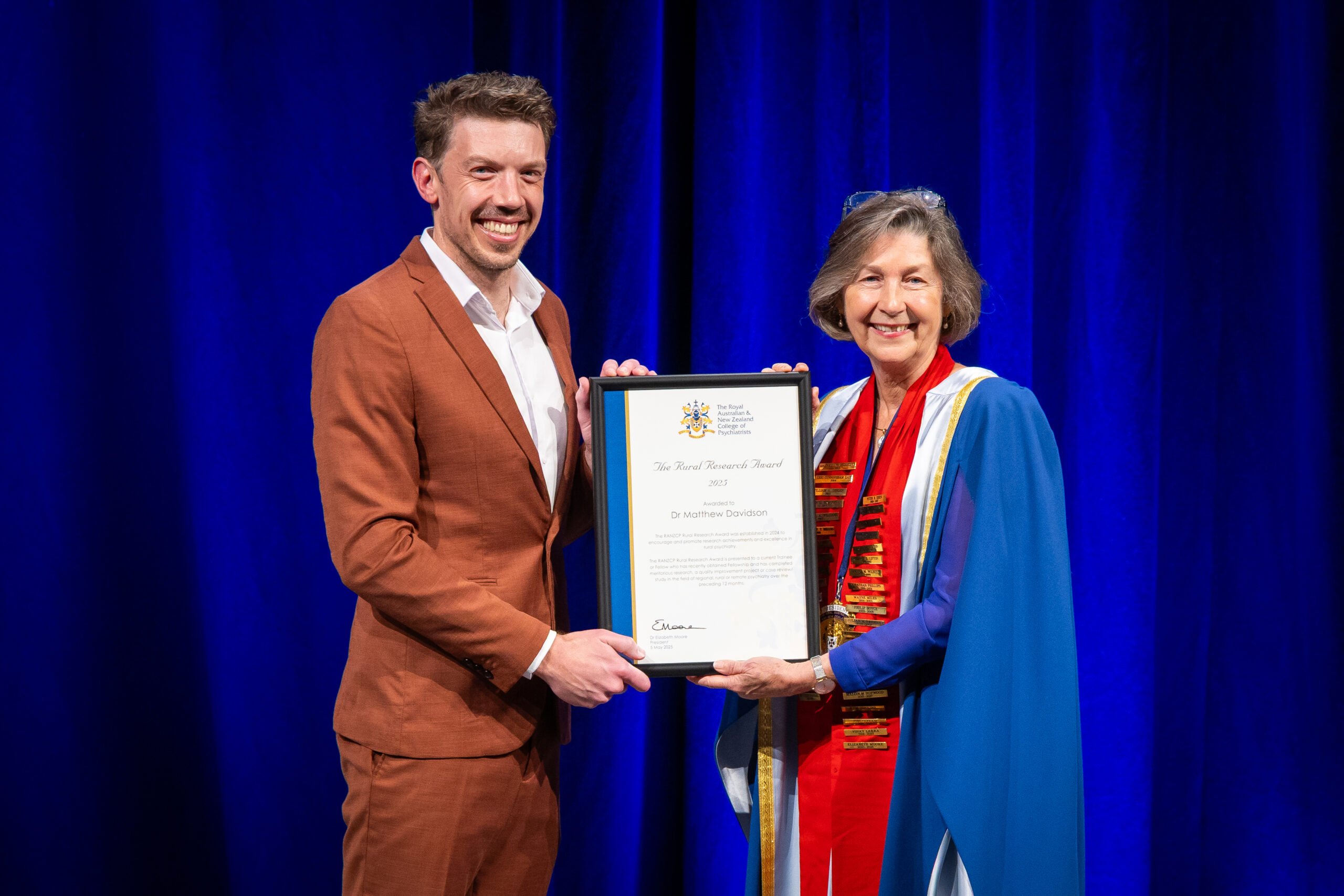
In June, Matt was awarded the Rural Research Award at the 2025 Royal Australian and New Zealand College of Psychiatrists Awards. He was recognised for his work in youth mental health in rural psychiatry.
The annual prize is awarded to a trainee and is an incentive award, designed to encourage research achievements and excellence in rural psychiatry.
Matt’s story reminds us that sometimes the most unfortunate events can give us a different perspective that leads us down a different path, that maybe was meant for us all along.