The Pilbara is one of Australia’s hardest places to recruit doctors, but also a region of enormous opportunity – which is precisely why aspiring doctors need to experience it for themselves.
For many people, the Pilbara is synonymous with mining. But for the health professionals who choose to build careers there, the region offers something very different – diverse and rewarding clinical work, strong community connections, opportunities to improve Aboriginal health outcomes, and access to some of Australia’s most spectacular natural landscapes.
Changing perceptions of the region is one of the reasons Rural Health West delivers the Junior Doctors Pilbara Immersion Program (JDPIP), providing early-career doctors with firsthand exposure to life and medicine in one of Western Australia’s most under appreciated regions.
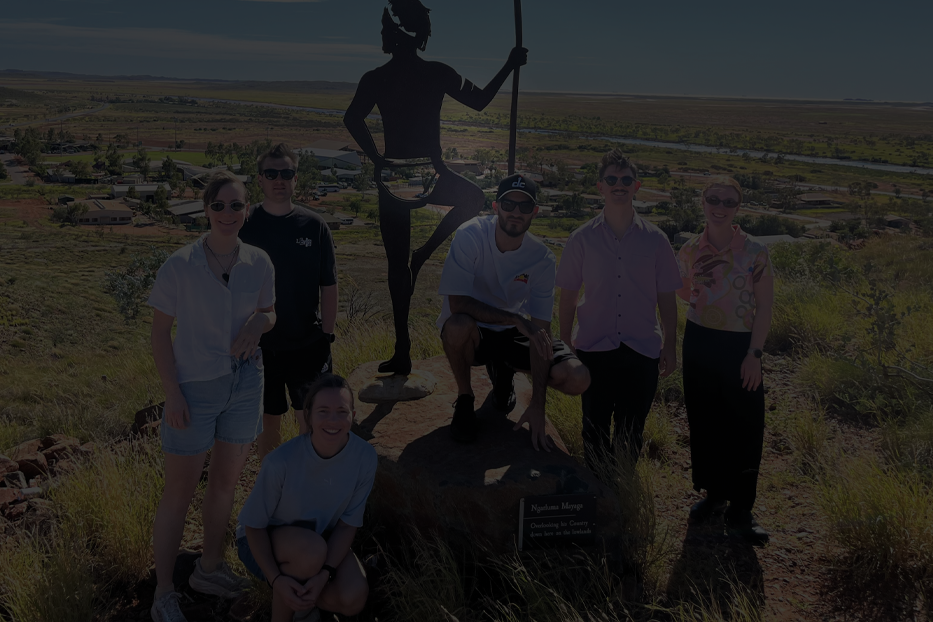
The program, which was held in May 2026, was sponsored by the Australian College of Rural and Remote Medicine (ACRRM) and toured six junior doctors through Port Hedland and Karratha, meeting local health professionals, visiting health services, and experiencing the communities they may one day serve.
Rural Health West Manager Workforce Solutions Beth McEwan said immersion experiences were critical in helping future doctors develop a true understanding of rural and remote practice.
“Despite offering some of the most rewarding career opportunities available, it has been tough to attract doctors to the Pilbara,” Beth said.
“Many people who haven’t spent time here picture mining towns and long distances. What they don’t see are the incredibly strong communities, the lifestyle opportunities, the natural beauty of the region and the chance to make a genuine difference in people’s lives.
“For doctors interested in rural medicine, the Pilbara offers an opportunity to practise broad and interesting medicine and contribute to improving health outcomes for Aboriginal people.
“That’s why programs like JDPIP are so important. You can tell someone about the Pilbara, but until they experience it for themselves, it’s difficult to appreciate what the region has to offer.”
A highlight of the immersion was engagement with the region’s Aboriginal Community Controlled Health Organisations (ACCHOs), which are central to Aboriginal healthcare in the region.
For participant Daniel Curran, the visit to Yaandina Aged Care in Roebourne was a standout experience.
“Connecting with the residents was the absolute highlight for me,” he said.
“I gained a much better understanding of the different Aboriginal Medical Services and their whole-of-person approach to providing care. The experience strengthened my commitment to continue working in rural communities.”
Fellow participant
Tara Boyhan said the week reinforced her interest in pursuing a rural career. “It’s made me want to do it even more,” she said.
“I especially enjoyed visiting the Mawarnkarra Health Service and seeing the positive impact it has within the community. It was incredibly uplifting and made me want to be part of that kind of work.
“Meeting the doctors out there and hearing about their experiences was really inspiring. Most have a good work-life balance – which has been one of my concerns about rural practice – so that was reassuring to learn.”
For Zoe Polglase, the immersion offered insight into both the professional and personal aspects of rural practice.
“JDPIP was extremely eye-opening and gave me experiences I’m unlikely to otherwise have this early in my career,” she said.
“I was struck by the collegiality among health professionals and the strong sense of community. It made me realise that rural practice may be a good fit for me after training.”
After visiting the Pilbara’s coastal communities, the group headed inland to attend the Rural and Remote Retrieval (RRR) emergency medicine training weekend in Karijini National Park.
“The junior doctors got to work alongside other clinicians and under the tutelage of some of our best emergency doctors – all while enjoying the stunning Karijini gorges,” Beth said.
“The emergency scenarios are a great way to develop clinical skills, teamwork and confidence in a wilderness setting.”
All six junior doctor participants are considering a career in rural generalist medicine through an ACRRM fellowship training.
ACRRM fellowship training aims to strengthen the future rural workforce by encouraging more doctors to pursue rural generalist training and establish long-term careers in regional Western Australia.