
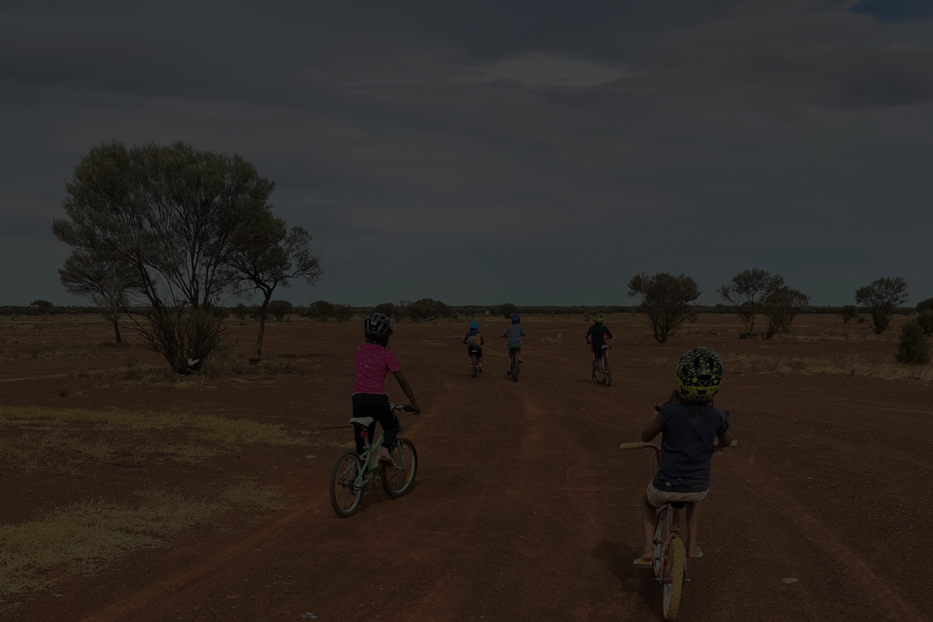
For almost a decade, a simple bicycle has been opening doors to better health, stronger relationships and brighter futures in one of Western Australia’s most remote communities.
On the edge of the Great Victoria Desert, the Laverton Cycling Project has grown well beyond teaching children to ride. Today it is helping young people build confidence, creating opportunities to learn, encouraging healthy lifestyles and strengthening connections across the community.
For project coordinator Dr Sabine Bird, the bikes have never been the destination.
“They’re simply the vehicle,” she says. “The real purpose is helping people discover confidence, build relationships and recognise what they’re capable of achieving.”
An accomplished neuroscientist with a PhD from the University of Western Australia, Sabine has taken an unconventional path. Her career has included Alzheimer’s research, supporting people affected by cancer, working with postgraduate students and coaching competitive cyclists.
Rather than following a traditional academic career, she chose to invest her expertise where she believed it could have the greatest long-term impact.
“My professional decisions have increasingly been guided by my commitment to the Laverton community,” she says. “That hasn’t always been the easiest path, but it has been the most meaningful.”
It is a decision that reflects widespread recognition that health is shaped by far more than clinical care alone – and that connection, purpose, physical activity, education and community participation are vital to wellbeing. It also through these attributes that small, close-knit communities have developed lasting resilience.
The Laverton Cycling Project is one example of that philosophy in action.
Each month Sabine completes a round trip from Perth to Laverton to deliver the program, which has expanded into nearby communities including Mulga Queen and Cosmo Newberry.
Alongside cycling skills, participants engage in science activities, leadership development, healthy lifestyle education and opportunities that broaden their horizons beyond their own community.
“The conversations that take place are so valuable,” Sabine said. “When people feel safe, connected and supported, that’s when they begin to see new possibilities for themselves.”
That sense of trust has been built through consistency rather than grand gestures.
For almost nine years, Sabine has continued making the now monthly journey regardless of changing professional roles or personal commitments.
“You earn trust by showing up,” she said. “Relationships develop over time, and that’s where lasting change begins.”
The project continues to evolve alongside the community’s needs.
Recently it expanded beyond youth programs, delivering its first adult health and wellbeing seminar for Laverton women. The response exceeded expectations, but Sabine says the real success came afterwards.
“What mattered most wasn’t simply that people attended,” she said. “It was hearing that the discussions continued long after the session finished. That’s how communities learn together.”
While cycling remains central, the project has become a platform for something much broader – creating opportunities for learning, wellbeing and connection across generations.
Sabine believes meaningful community change rarely happens overnight.
“Real change usually happens gradually,” she says. “Small experiences accumulate, people gain confidence, relationships deepen, and over time communities become stronger.”
Her work demonstrates that improving health in rural and remote Australia can start by creating opportunities for people to connect, participate and belong.