
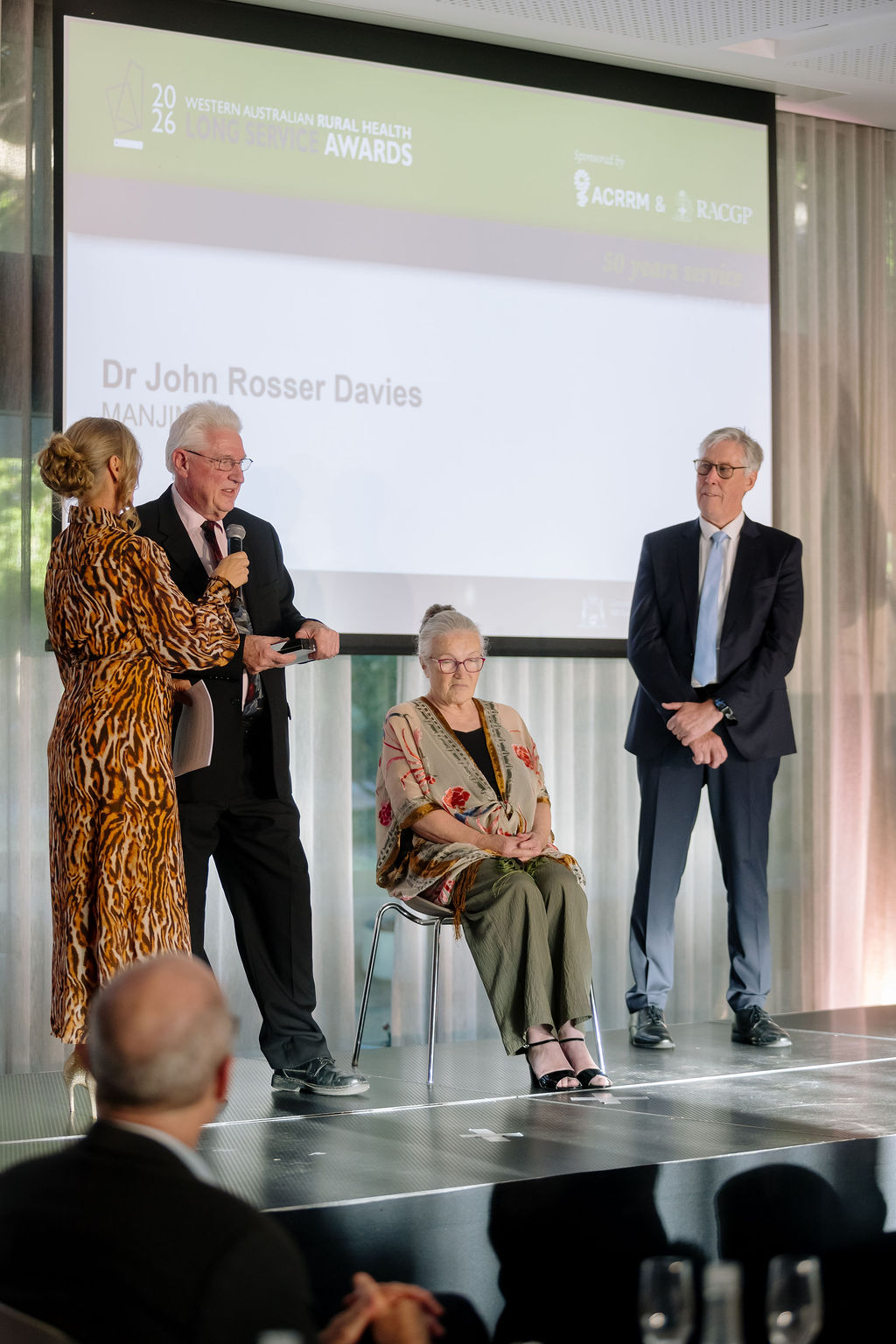
This year’s WA Rural Health Long Service Awards recognised Dr John Rosser Davies for an extraordinary milestone – 50 years of service to rural Western Australia. It is a legacy that began almost by chance, when he left the United Kingdom in 1976 with plans of a globetrotting working holiday.
“I’d planned to have a three-year working holiday in Canada, New Zealand and Australia, but I didn’t get past Western Australia,” John said.
Initially taking on locum GP roles across country WA, John arrived in Manjimup in 1978 for what was meant to be another short-term placement. It became something far more permanent, when he established Manjimup Medical Centre the following year, marking the beginning of a lifelong commitment to one community and its people.
Over the decades, John has come to embody the scope and adaptability of rural general practice. His career has spanned obstetrics, anaesthetics, surgery, emergency medicine and aged care – an extraordinary breadth reflecting both the challenges and rewards of working in the country.
“From a career perspective, I’ve grown up in Manjimup, doing obstetrics, anaesthetics, surgery, accidents and emergencies, and all sorts of things,” he said.
His versatility and dedication to serving his local community saw John do what few doctors in Australia have ever achieved – he is recognised as the only rural doctor in Western Australia to have provided surgical, anaesthetic and obstetric services concurrently.
John was Manjimup’s sole obstetrician for 19 years, and over the course of his career, he has delivered more than 1,500 babies, often caring for multiple generations within the same family.
However, he has not just been present for births. John has supported patients and their families through illness, crisis and end of life. Long before it became widely recognised in Australia, he pioneered home-based palliative care, guided by a belief in dignity, familiarity and patient choice.
“In the UK, where I come from, dying at home was normal. Dying is simply a part of living and we recognised that and supported it.
“People found they would like to die in their own homes instead of what is potentially an unfriendly, sterile area in hospitals. We had a wonderful nurse here with a similar interest, so that’s what we did.
“This type of care was then taken over by Silver Chain, and now lies with the State Government, where dying at home is an option for those in palliative care.
“It offers people an opportunity to do what they want, when they want,” he said.
While patient care has always been central to his work, John has worn many hats; teacher, mentor, community leader and advocate.
He served as long-term Chair of the local Medical Advisory Committee and contributed extensively to education and workforce development. Over his career, he has mentored more than 80 medical students, with 12 progressing to GP registrar training and two choosing to remain in Manjimup long term. Today, the town benefits from a strong, multi-doctor workforce, something that once seemed unlikely.
His commitment to education extends through his work with the University of Western Australia’s Clinical Training and Evaluation Centre (CTEC). As a long-standing faculty member and Co-Convenor, he has helped train countless doctors through the Cutting Edge workshops, earning CTEC Platinum Convenor status in recognition of his contribution.
John’s influence also reaches into community health and prevention. He has served as treasurer of the Asthma Foundation, delivered antenatal and first-aid education, and, for more than 15 years, led the RISK (Risk Intervention to Save Kids) Road Safety Program. Through this initiative, he has spoken with Year 11 students about the realities of trauma care, helping young people understand the consequences of unsafe driving and encouraging them to change their attitudes and behaviour about driving.
Always community-minded, he also served as president of Manjimup Rotary Club, where he supported numerous local initiatives. It reflects his belief that healthcare and community wellbeing are closely connected.
Reflecting on his career, John speaks not of achievements, but of people.
“The most rewarding part of my 50 years has been meeting and taking care of my patients and seeing the changes in general practice in the country.”
As John receives his 50-Year WA Rural Health Long Service Award, Manjimup celebrates a doctor and recognises a neighbour, mentor and leader who has been a constant presence for half a century.
Dr John Rosser Davies’ story is a powerful reminder that rural medicine is defined not by limitation, but by connection, versatility and community, and his legacy in Manjimup will continue to be felt for generations to come.